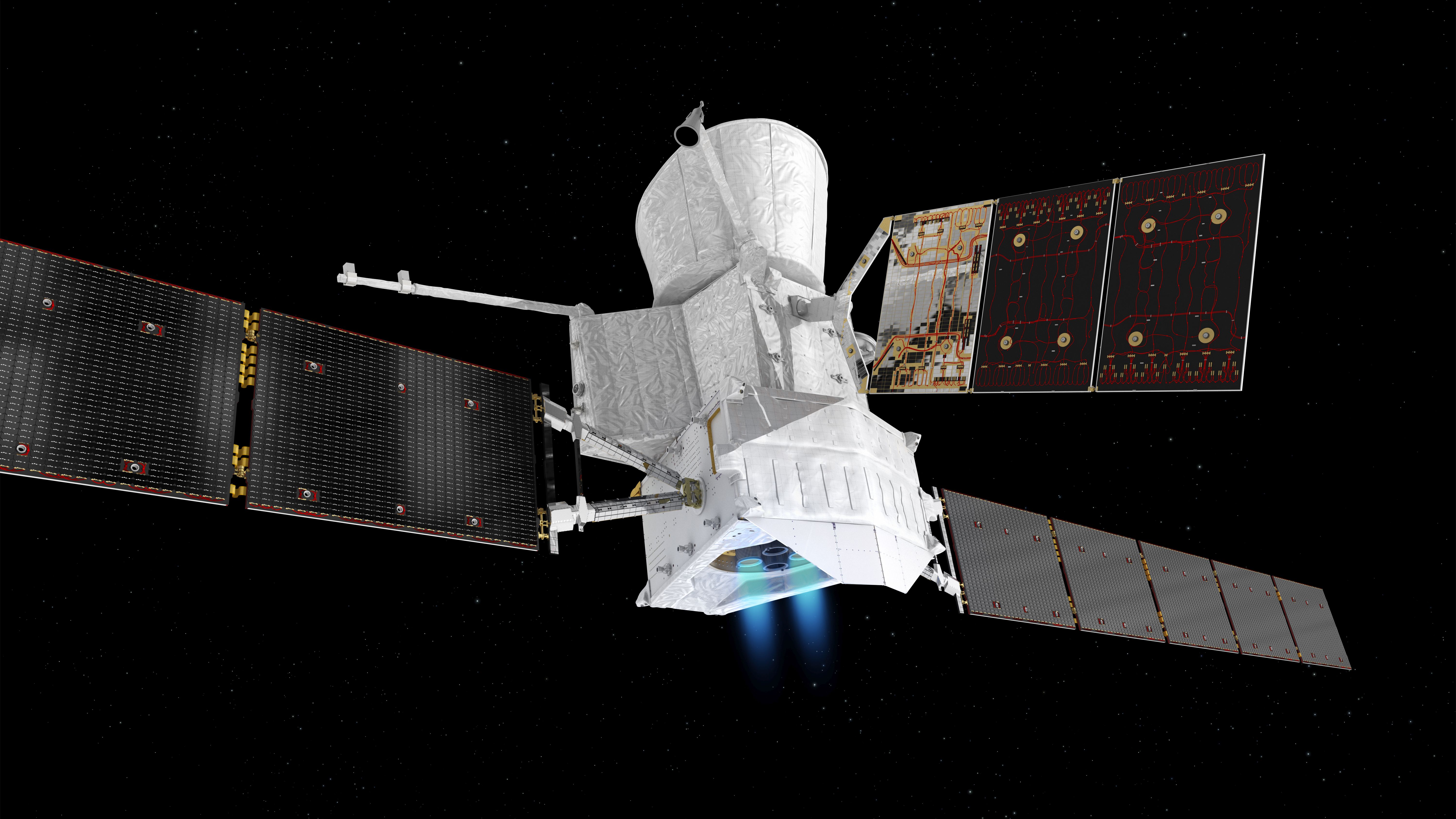
The BepiColombo mission to Mercury has blasted off into space, beginning its exciting mission to study the closest planet to the Sun!
BepiColombo is a joint mission between ESA and the Japan Aerospace Exploration Agency, JAXA. It includes two science craft designed to orbit Mercury: ESA’s Mercury Planetary Orbiter, and JAXA’s Mercury Magnetospheric Orbiter. ESA have built a special craft called the Mercury Transfer Module to take the orbiters to Mercury. All these things together make BepiColombo!

The Mercury Transfer Module is now carrying the two orbiters to Mercury. It is moving through space using solar electric propulsion, and gravity assist flybys – when a craft zooms around a planet, using gravity to change its speed and direction! The Mercury Transfer Module will actually complete one flyby of Earth, two at Venus, and then six at Mercury! In late 2025 it will enter into a stable orbit around Mercury. This seven-year journey is called the cruise phase.
Travelling to Mercury will be very difficult. BepiColombo will experience extreme temperatures, from the incredibly cold -180°C, to over 450°C – hotter than the inside of a pizza oven! Many parts of the spacecraft, including its outer coatings, had not been tested in these conditions before. However, ESA and JAXA are experts at space missions, and BepiColombo has been built very well!

A few months before arriving at Mercury, the Transfer Module will disconnect, leaving the two science orbiters to be captured by Mercury’s gravity. They will use thrusters to move into orbit around the planet, and then separate so that they can gather data from different points above Mercury. They will make measurements to reveal what the surface and inside of Mercury are like, along with how geological features – including ice in the planet’s shadowed craters – formed and changed over time. They will even investigate how the planet is affected by charged particles from the Sun, known as the solar wind.
Jan Wörner is ESA’s Director General. He says, “Launching BepiColombo is a huge milestone for ESA and JAXA, and there will be many great successes to come. Beyond completing the challenging journey, this mission will return a huge bounty of science. It is thanks to the international collaboration and the decades of efforts and expertise of everyone involved in the design and building of this incredible machine, that we are now on our way to investigating planet Mercury’s mysteries.”

Cool fact: the Mercury Planetary Orbiter and Mercury Magnetospheric Orbiter will actually be able to operate their instruments during the cruise phase, collecting valuable data when close to Venus!


