
European scientists want to send a rover to search for signs of life on Mars. That was the message after a two-day ESA meeting held last week in Birmingham, England.
Mars is the most Earth-like of all the planets, and the most likely place – beyond Earth – for primitive life to exist. Information coming back from ESA’s Mars Express orbiter suggests that the Red Planet was once much warmer and wetter than it is today.
Does liquid water lie beneath its frozen surface? If so, does simple life survive there? In order to answer these mysteries, scientists want to explore the surface of Mars with a state-of-the-art rover.
The proposed mission would lift off in June 2011. After a two-year journey, airbags, and possibly retrorockets, would be used to cushion the rover’s landing on Mars.
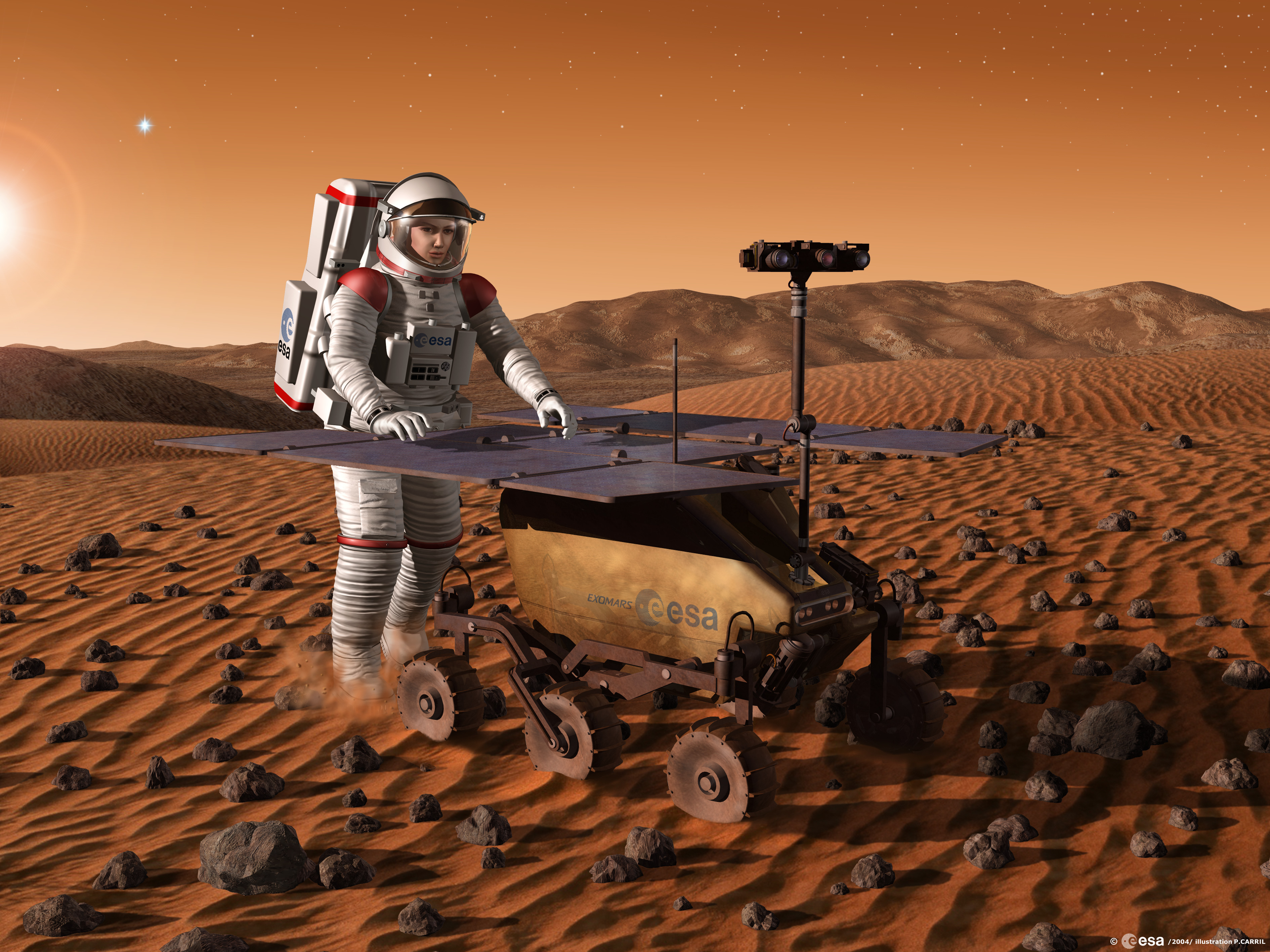
One of its main tasks would be to search for traces of life – past or present. Included in the rover’s payload would be a gas analysis experiment to look for chemical signs of life in the atmosphere.
A drill on the rover would obtain rock and soil samples from a depth of 2 metres. These would also be studied with the gas analysis experiment.
Other instruments on the rover would search for water, study the subsurface rock layers and measure Marsquakes. They would also identify hazards that could threaten future human missions.
Looking further into the future, the scientists confirmed their commitment to taking part in an international Sample Return Mission in 2016.


