Before there were worlds, oceans, or even solid ground, there was something far less impressive: a cloud. A vast, cold mixture of gas and dust drifting through space. No continents, no atmospheres, no life, just tiny particles floating in the dark. From this unassuming beginning, entire solar systems are built!
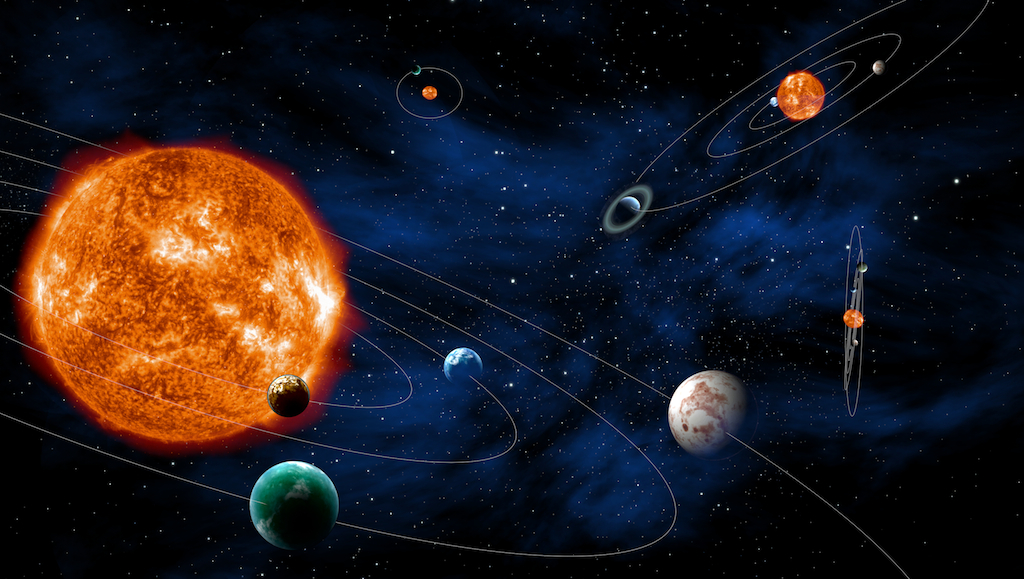
Understanding how this transformation happens is a key part of the science behind ESA’s Plato mission. By studying planets around other stars, Plato helps scientists to piece together not just a map of planets in our Galaxy, but how they form in the first place.
Step one: a star is born
Everything begins when part of a giant cloud of gas and dust collapses under its own gravity. As it shrinks, it spins faster and flattens into a disc, like pizza dough being spun in the air. When enough material has come together at the centre, a star ignites. Around it, a swirling disc of gas and dust remains. This is called a protoplanetary disc, which means a planet-forming disc. The area around the star where planets are born.
Step two: from dust to pebbles
At first, the disc is filled with microscopic grains, smaller than sand. But these grains don’t stay lonely for long! They collide gently and stick together, building larger and larger clumps. Dust becomes pebbles, and pebbles continue to grow.
It might sound slow, but this process happens across enormous scales, with countless collisions taking place at once. Over time, these small building blocks become kilometre-sized objects known as planetesimals. They’re like the first “seeds” of planets.

Step three: collisions build worlds
Once planetesimals form, gravity begins to take over. Larger objects pull in smaller ones, and collisions become more dramatic. Some smash together and merge, growing bigger. Others break apart, feeding material back into the system.
This chaotic stage leads to the formation of planetary embryos, which are objects large enough to have significant gravity. But they are not yet full planets.
Over millions of years, these embryos continue to collide and combine, gradually clearing out their orbits and growing into fully formed planets. The largest bodies grow by sweeping up smaller ones, until only a few dominant planets remain. Survival of the fittest, planetary style!
Step four: growing up and gaining atmospheres
As planets grow, they begin to change. Rocky planets like Earth build solid surfaces from cooling after a period of repeated impacts. At the same time, gases released from their interiors through volcanic activity can form atmospheres.
In the outer regions of a system, where it’s colder, something different happens. Large planetary cores can gather vast amounts of gas, becoming gas giants like Jupiter and Saturn.
This is why solar systems often contain a mix of worlds: small, rocky planets closer to the star, and massive gas giants. These differences all trace back to conditions in the original disc.
Not all solar systems are the same
One of the most exciting discoveries in modern astronomy is that planetary systems can look very different from our own. Some have giant planets extremely close to their stars. Others may contain tightly packed systems of small rocky worlds. Most excitingly, some even host planets in the habitable zone, where conditions could allow liquid water to exist on the planet’s surfaces.
The Plato mission is designed to study these systems in detail, helping scientists understand not just what planets exist, but how they came to be.

A process that takes time
It’s easy to think of planets as permanent fixtures, but in reality they’re the result of a long and delicate chain of events. A gas cloud collapses, a star ignites, dust clumps together, and collisions build worlds. Each stage builds on the last, unfolding so slowly that the changes would be almost impossible to notice on human timescales. Planet formation doesn’t happen overnight, but rather unfolds over tens of millions of years, shaped by gravity, motion, and countless collisions.
Even after planets form, they continue to evolve as orbits shift, atmospheres change, and surfaces are reshaped by impacts. In other words, a planetary system is never truly finished. Somewhere along that chain, if conditions are just right, a planet like Earth might emerge. The Plato mission aims to find Earth-like planets and will help us to find out whether they are common, or whether our planet might be one-of-a-kind.


